Carers of Australians with Dementia to receive support through innovative new digital tool

Aged Care

Last updated

5 July 2021

Reading time

3 min read

Share

My Dementia Companion receives $10,000 from Mable Community Grants to support the 1.6 million Australian carers impacted by dementia
Friends, families and carers of the 470,000 Australians living with dementia1 will soon have access to further support and knowledge sharing, thanks to funding by Mable Community Grants. 

My Dementia Companion is one of two grant recipients to receive funding as part of the Mable Community Grants inaugural program, launched last year by Mable, an online two-sided community for aged care and disability support. Both aim to promote independence for people with disability and older Australians. The innovative tech-lead organisation was chosen from over 80 entries to receive the grant to support advancements to the tool that arms carers of Australians living with dementia with practical tips and information.

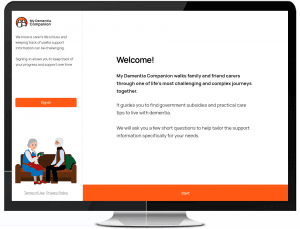
My Dementia Companion is an easy to use online tool designed for the 1.6 million Australian carers supporting those living with dementia1 which optimises the experience of families using dementia support information to live well in our community. With a personalised experience for each unique user, My Dementia Companion intuitively provides bite-sized support videos and articles from experts and practical tips from other carers. 

Nan Yu, Founder and Chief Executive Officer of My Dementia Companion, said: “One of the biggest challenges in dementia care is that the support information for families and carers can be overwhelming and as the disease has such a broad spectrum, it’s hard to find information suited to one’s journey. Thanks to the additional funding from Mable Community Grants, we can further enhance the My Dementia Companion tool to better help families and carers manage what can be a  challenging, hard to understand and isolating experience.”

More and more families in Australia are impacted by Dementia, the greatest cause of disability in older Australians and the third leading cause of disability burden overall1.  The Mable Community Grants judging panel recognises the need for more support programs that give families tools and information to prepare for and manage the changing dynamics that come with a Dementia diagnosis, to ensure recipients and their family members can continue to live fulfilling lives. 

Peter Scutt, CEO and Co-Founder of Mable, said: “Mable Community Grants was established to fund innovative projects that are focused on fostering true inclusivity within the community for older Australians and people with disability. My Dementia Companion delivers against this by enabling people with dementia to live full lives through targeted carer support.” 

The Mable Community Grants initiative was launched in 2020 and supports people and projects working toward improving independence and inclusion. The grants provide a platform for the community to be a catalyst for change they most want to see in society.

Click here to learn more about the Mable Community Grants initiative and its grants.

Click here to learn more about My Dementia Companion.

You might be interested in

NDIS reforms announced: What we know so far
We know recent news about NDIS reforms might feel heavy. For many of you, your participants, and your loved ones, hearing about potential service caps or changes to funding for social and community participation is deeply stressful. We want to start by saying: we hear you, and we are here for you. Our commitment to you remains unchanged While the government works through these changes, we want you to know Mable's business model is not changing. Our platform continues to be a place where you can find and book independent support workers who best meet your needs or those of your clients. While we may make a few small technical updates behind the scenes, your ability to use Mable remains exactly as it is today. We're your partner and advocate During this transition, we're dedicated to supporting safe, transparent connections. We are actively advocating for person-centred approaches to care that respect your choice and control, and we'll keep helping our community understand what these r
Disabled mums are the quiet supermums
As the water trickled over the rocks and my kids explored the bush, their laughter mingling with birdsong, I sat quietly on the wooden seat, taking it all in. The peace, the joy - but also something else. My eyes welled up just as my independent support worker glanced at me. She slipped an arm around me and gave a gentle squeeze. I didn't need to explain what I was feeling but she already knew. That feeling is something that I think every parent living with a disability needs to hear and embrace. A different kind of angst Mum - and dad - guilt is almost synonymous with parenting these days. We worry we're not doing enough, not being enough; that there's never enough time, money, or energy. But when you're parenting with disability, that feeling cuts deeper. It's the sting when you can't do something for, or with, your kids. Like driving them to a birthday party, kicking a soccer ball in the backyard. It's crying quietly in the kitchen when disability and parenthood all feels too much.
Independent Thoughts: Melissa and Simone
Independent Thoughts digs deeper into what it really means to live on your terms, sharing insights into life for people with disability and older Australians. We invite guests with lived experience to share their perspectives in an open dialogue. From casual chats to asking some of life's biggest questions, Independent Thoughts covers it all. Independent Thoughts is an invitation to join us as we challenge the status quo, shatter stereotypes, and redefine independence – one open-hearted conversation at a time. In this episode, we meet Simone, who manages support for her dad, Con, through Mable. She speaks with host and Clinical Psychologist, Melissa Levi . Finding the right support Dogs, flowers and a veggie garden. These are three things that bring Con joy, according to his daughter, Simone. But as he got older, it became physically harder for him to stay connected to the parts of life he loved. When Con and Simone felt it was time to begin looking for help at home, it was import