
This article was written by the two lead Facilitators of Community Resource Unit's (CRU) Inclusive Education who work with families of children with disability. They have both navigated the school system for an inclusive education for their own children with disability. They work to support parents to be clear, confident and connected in their advocacy efforts for inclusive education.
For families seeking inclusive education for their child with disability, traditional and outdated ways of thinking by others can create real and ongoing barriers. Challenging these attitudes and building understanding of inclusion often requires parents and carers to step into the role of advocate. While standing up for our children is something most parents would willingly do, advocacy is often thrust upon us without preparation, training or choice.
In this article, we will share what genuine inclusive education is, and some advocacy learnings from families who have navigated inclusion for their child with disability.
What is inclusive education?
Inclusive education means that all students attend and are welcomed by their neighbourhood schools in age-appropriate, regular classes and are supported to learn, contribute and participate in all aspects of the life of the school.
Successful advocacy for inclusive education requires parents and carers to have a clear understanding of the core elements of inclusive practice. This understanding builds confidence and clarity, ensuring that advocacy efforts are focused on what will genuinely lead to inclusion. As many parents and carers have not personally experienced inclusive education themselves, learning what inclusive education is (and what it is not), is an essential starting point.
Inclusive Education is:
What does Inclusive Education look like?
- Students with disability learning alongside their non-disabled classmates, engaging with the same curriculum, with reasonable adjustments and appropriate supports in place.
- Social, communication, and sensory needs being understood, respected, and proactively supported.
- Intentional structures that enable students with disability to fully participate, contribute, and build genuine friendships across the school day — in classrooms, playgrounds, and extra-curricular activities.
Inclusive education is not:
- Families or students feeling unwelcome, or that requests for adjustments and support are an inconvenience or burden to the school.
- Students with disability being routinely separated from their peers, seated apart in classrooms, grouped together in "special" classes or programs, or excluded into separate play spaces during break times.
- Students with disability being placed in regular classrooms and school related spaces without the necessary adjustments being made to the environment or to instruction to ensure physical, social and curriculum inclusion.
- A teacher-aide being assigned to a student with disability most of the school day and taking responsibility for teaching and modifying learning.
Visit Community Resource Unit's (CRU) website for resources on understanding inclusive education.
Advocacy - What is helpful?
An advocate is someone who stands up for something. In this case, someone who stands up for a child's right to an inclusive education.
A critical first step in being an effective advocate is to embrace your natural authority as a family member. You know your child best and you hold the vision for their future. Your child needs you to be a decisive voice for them.
Advocacy requires building a positive relationship with the school, even if there are times of disappointment or disagreement. If you focus on the vision and progress, it is easier to find common ground and keep discussions moving forward.
Vision statement
Have a clear vision statement that details your child's and family's hopes for the school years and beyond. Vision statements focus on what is typical and ordinary for any child.
Example: Will's Vision
We will see Will attending his local high school until Year 12. We see Will making good friends and enjoying all that high school has to offer.
As an adult, we see Will as a valuable member of the community.
We see Will living in a home of his choosing and having lifelong friendships.
We see Will travelling, holidaying, and having adventures.
We see Will being employed in a job that he enjoys, and that provides him with the funds to live a good life.
We see Will making his own choices and doing the things he enjoys.
Learn more about vision statements.
Tips for building a positive relationship with school:
- Speak positively and enthusiastically. Aim to inspire something better rather than being tempted to criticise. Remain calm and factual. Using assertive 'I' language in your communication can assist in avoiding blame.
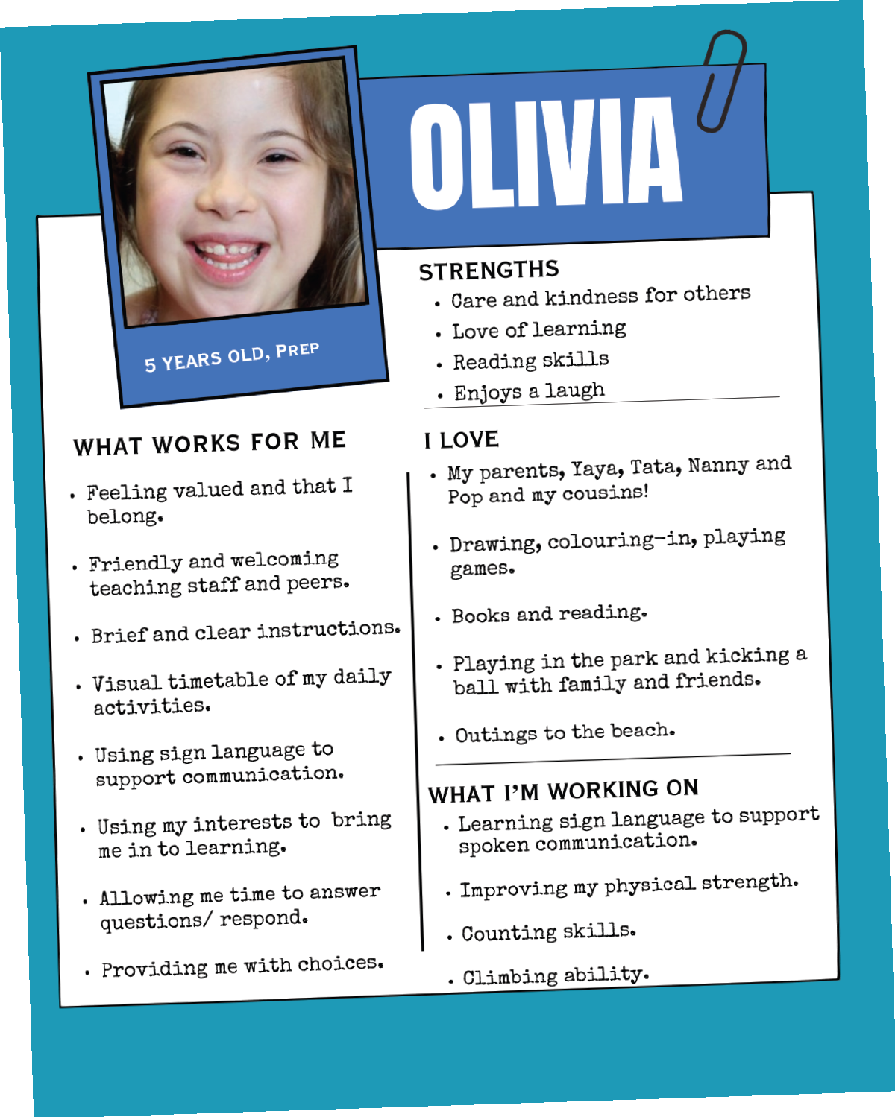
- Think of yourself as your child's ambassador – bring their voice to conversations, highlighting their strengths and gifts, even when they make mistakes. A one-page profile is an effective way to share who your child is and what supports and adjustments work best for them.
- Your views are more likely to be heard if you acknowledge and appreciate what is done well by the school. Try to thank and praise regularly.
- Be an involved member of the school community. Being known as a contributor helps you to build allies and your advocacy is more likely to be well regarded.
- Be curious rather than defensive when faced with a proposal you are not sure about. E.g. "Tell me more how this may promote Stella's progress in maths?"
- Strive for a resolution and sort out the big vs little issues. Don't get caught in micromanaging the school. You may have to let some things go to maintain a positive relationship.
Student Self-Advocacy
Advocacy often requires long-term parent commitment. It is important to keep in mind that our children are watching and are learning advocacy skills from us. We can also further build our children's self-esteem and advocacy skills by asking them what supports work well, involving them in creating their vision and one-page profile documents and including them in meetings.
Example of a one-page profile:
Visit CRU's website for resources on working collaboratively with school staff.
Advocacy in the long-term
There will be ups and downs through the school years. Below are learnings shared by parent advocates on what helped them to stay the course.
Tips for maintaining your advocacy efforts:
- Connect with other families who are treading a similar path to you. When we are isolated it is very easy to feel defeated. Connecting with others who understand your vision for an inclusive education and the barriers you face can be lifesaving. Find out about local parent peer inclusive education support networks by contacting your closest NACBO (National Alliance of Capacity Building Organisations) member.
- Try not to overwhelm the school with information or demands. Use the BIFF (Brief, Informative, Friendly, Firm) technique as a guide. Identify one or two changes that would make the biggest difference to your child's success.
- Keep good records. Make brief notes during and after phone calls, conversations and meetings (dates, who was present, what was said) and keep a record of emails. It can be helpful to follow up a conversation with an email which summaries key points and actions that were decided upon.
- Don't feel pressured to agree to something on the run. State that you need time to think before making important decisions. Return to your child's 'vision statement' for guidance on what choice is most likely to bring them a step closer to achieving their vision.
- Use formal processes where possible. Give the teacher and school the chance to respond and improve before escalating concerns. If the issue remains unresolved, use the education system's formal complaints process. Formal advocacy may also be an option – it may help to contact disability advocacy organisations in your state or territory to explore what is available.
- Don't aim for perfection, mistakes will be made. Genuine inclusive education requires social and cultural change. This takes time, collective effort, and a willingness to challenge long-held beliefs. Allow others space to process new ideas, to learn from mistakes, and draw on what shifted your own thinking to support their next steps.
Visit CRU's website for resources on barriers, rights and advocacy.
About Community Resource Unit
Community Resource Unit (CRU) is a Brisbane-based not-for-profit organisation with statewide reach across Queensland. They are members of NACBO (National Alliance of Capacity Building Organisations).
For nearly 40 years, CRU has gathered and shared the insights, experiences and strategies of parent advocates who have sought an inclusive education for their child with disability.
You can contact CRU's Inclusive Education team by emailing educationproject@cru.org.au or by phoning (07) 3844 221.